

Monday, April 18, 2011

Saturday, April 16, 2011
More Sewing Projects
Kari and Bryce are enjoying a getaway to Glen Ellyn this weekend. Kevin and I are taking advantage of the time by...cleaning. How romantic.
It seems like it has consistently been cold, rainy and windy around here- just perfect to stay inside and work on some sewing projects.
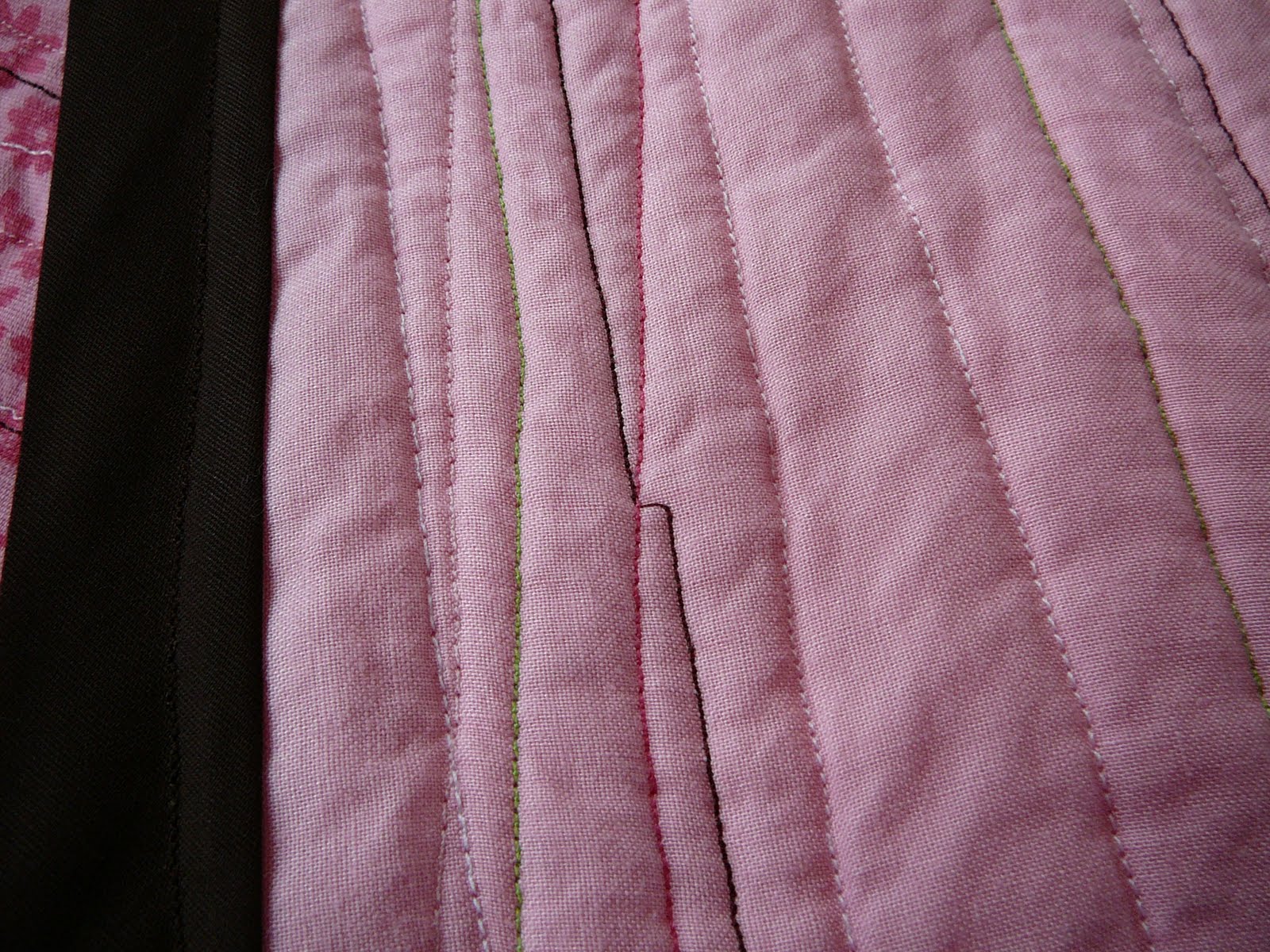
This first project I have self-titled "The Forgiving Blanket". A dear friend of mine from high school, Anne, had a baby a couple months ago and I found what looked to be a really easy pseudo quilting tutorial. It was fun selecting the fabrics and contrasting thread.


I call it forgiving because of the nature of the quilting. Any small mistakes are easily lost in the rest of the blanket.

It seems like it has consistently been cold, rainy and windy around here- just perfect to stay inside and work on some sewing projects.
This first project I have self-titled "The Forgiving Blanket". A dear friend of mine from high school, Anne, had a baby a couple months ago and I found what looked to be a really easy pseudo quilting tutorial. It was fun selecting the fabrics and contrasting thread.


This was a ton of fun to put together.
I seemed to be on a positive roll with the whole blanket thing, so in preparation for Bryce's transition to his new school with Kari, I made a simple flannel blanket. No frills, just two pieces of flannel and some handmade bias tape. I'm still awful at making 90 degree corners, but it's only a blanket for daycare, so I let it go. He also got a matching pillow with some of the remaining fabric.


The bag is huge-Bryce could sit in it- but I didn't want the problem we currently have with Kari's bag- too small. I probably went a bit overboard, but it should be practical even after his daycare days end.
Isn't the fabric awesome? I wanted to give it some visual interest and masculinity beyond the fish and incorporating grommets seemed like a good way to do that. Never working with grommets before, I was quite pleased with how they turned out. I did realize after the first one that, technically, there is a front and back to the pieces, but anyone would be hard-pressed to notice unless up close.


I seemed to be on a positive roll with the whole blanket thing, so in preparation for Bryce's transition to his new school with Kari, I made a simple flannel blanket. No frills, just two pieces of flannel and some handmade bias tape. I'm still awful at making 90 degree corners, but it's only a blanket for daycare, so I let it go. He also got a matching pillow with some of the remaining fabric.

And, Bryce couldn't go to school without a bag to tote his blanket and pillow each week.

Isn't the fabric awesome? I wanted to give it some visual interest and masculinity beyond the fish and incorporating grommets seemed like a good way to do that. Never working with grommets before, I was quite pleased with how they turned out. I did realize after the first one that, technically, there is a front and back to the pieces, but anyone would be hard-pressed to notice unless up close.


Other things going on around here? Well, Bryce officially loves watermelon. As in rind and all. He had a small tantrum when we pulled the rind out of his mouth.

Going...

Going...

Gone!


Going...

Going...

Gone!
Natalie got five baby ducks for their farm. They arrived in the mail. I guess this is not unusual, but for a city kid, it sounds really odd and borderline inhumane. Anyway, she had them at the daycare house in the bathtub and we had a chance to hold and pet the two week old fragile little guys. What a neat springtime/Easter opportunity!


Monday, April 4, 2011
First Days
Well, Bryce survived his first day at the new school with Kari. It was certainly not without tears, though.


After we left, we heard he pretty much cried himself to sleep in the arms of his teachers who then put him on the reading couch.


Doesn't he look like a little old man passed out on the couch from a long day of watching football?
Yesterday at church Kari and the other little kids were invited to sing "This Little Light of Mine" during the children's portion of the service. Clearly, Kari was quite enamored with the band.

Yesterday at church Kari and the other little kids were invited to sing "This Little Light of Mine" during the children's portion of the service. Clearly, Kari was quite enamored with the band.

Do you see her? She's the only one not facing forward.
Kari practiced her song all week. It was quite humorous to hear her version:
"...This little light of mine
I'm gonna let it shine
Don't let Jesus blow it out
Hide it under a bush..."
I'm gonna let it shine
Don't let Jesus blow it out
Hide it under a bush..."
And we capped off our Sunday by going to one of Kari's favorite restaurants: Dog'nSuds. Unfortunately it was terribly windy yesterday and made for a challenging picnic.


Friday, April 1, 2011
April Fools and Last Days
Today marked the end of a major chapter in our child-rearing life. Bryce's last day at Natalie's was pretty typical, aside from the celebratory "wear your jammies" to signify a last day or a birthday. It will be a sad day for every parent that has had Natalie care for their child as she permanently closes her daycare doors in May.
Natalie mentioned that Bryce was particularly cuddly today- I'm not sure if he instinctively knew what was going on or not. Monday will be a true test as he'll be going in virtually cold turkey as I have a program and must be at work all day. Natalie's confident he won't even notice; I'm not so sure.

To celebrate April Fool's day at Kari's school, the kids were supposed to dress silly. I wasn't sure what defined silly, so we went with clothes on backwards, mismatched socks, and some crazy hair-do. She seemed to fit in just fine.

And tonight we honored the day by having breakfast for dinner. Strawberry, banana and chocolate chip pancakes were on the menu. It was quite a hit and both devoured probably close to five pancakes each. Kari and I enjoyed making pancake "sandwiches"- one chocolate chip, one banana, smeared with peanut butter in the middle.

One of the things I've looked forward to the most since the day Bryce was born is the point when these two would be able to play together. They've steadily been playing more and more together for the last nine months or so, but this just really struck a chord with me this evening. Kari is such a caring, gentle and protective big sister. Here, she's taking Bryce out with her to fetch the mail, one of her daily chores, but never letting go of his hand knowing they have to get a bit into the street. She took a brief second to point out an airplane overhead.


Natalie mentioned that Bryce was particularly cuddly today- I'm not sure if he instinctively knew what was going on or not. Monday will be a true test as he'll be going in virtually cold turkey as I have a program and must be at work all day. Natalie's confident he won't even notice; I'm not so sure.


Friday, March 25, 2011
Crazy Town
So I recently found a nifty little on-line contest. Crafting? Creating? Something new? Certainly not me! But I was intrigued because it was a contest making a top for a boy. Hmmm. Little boy? Yup, I have one of those in my stash. Spray paint? Check. Silhouette and freezer paper? Check check. All I had to do now was come up with something original.
So, I've been thinking. A lot. This was not easy for me (the coming up with something new part, not the thinking part, friends) but I started thinking of what he's good at and how that could be incorporated into a shirt. At almost 20 months old he's definitely good at some things-- throwing food, throwing toys, screaming, squirming during diaper changes, and in general, driving me crazy.


Ah! And yet another thing the little guy is good at- running away from the camera! Wow, it's hard to take good pictures of a moving target! (Yep, I most certainly did hoist him up on the trunk of my car. That kept him relatively contained for about 33 seconds.)
So, I've been thinking. A lot. This was not easy for me (the coming up with something new part, not the thinking part, friends) but I started thinking of what he's good at and how that could be incorporated into a shirt. At almost 20 months old he's definitely good at some things-- throwing food, throwing toys, screaming, squirming during diaper changes, and in general, driving me crazy.


Tuesday, March 22, 2011
Lazy Days at Home
Our days like this are numbered.


A week from next Monday Bryce will be starting a new chapter in his life. His name was recently drawn for the next open spot at Kari's school. While this is an exciting time, it also means saying goodbye to Natalie who has cheerfully watched Kari and Bryce for more than four years, watching and caring for them like they were her own kids. I would not trade the in-home daycare experience for anything, but this, too, had to end.
This afternoon I brought Bryce to the center to introduce him to his new teachers, classmates and to check out the room. He'll be in with nine other toddlers and have two teachers. I sat with him for the first 30 minutes and then Kevin and I had parent-teacher conferences for Kari and Bryce was left in the room for 30 minutes without us, and surprisingly, did not cry. (I don't know, however, if he tried to stick his hand in anyone's mouth.)


This afternoon I brought Bryce to the center to introduce him to his new teachers, classmates and to check out the room. He'll be in with nine other toddlers and have two teachers. I sat with him for the first 30 minutes and then Kevin and I had parent-teacher conferences for Kari and Bryce was left in the room for 30 minutes without us, and surprisingly, did not cry. (I don't know, however, if he tried to stick his hand in anyone's mouth.)
Updated Car Seat Recommendations
Many have thought I was crazy for keeping Bryce rear-facing in his car seat beyond his first birthday. Allow me to share this with you: 

Executive Health March 21, 2011, 09:00 EST
Keep Kids in Rear-Facing Car Seats Until 2, Experts Say
Pediatricians' group says positioning kids longer in this way is safer
MONDAY, March 21 (HealthDay News) -- Children are best kept in rear-facing car seats until age two or until they have reached the height and weight maximums set by the car seat manufacturer, according to new recommendations from a pediatricians' group.
This is a significant change from the prior recommendations, which called for babies to stay in rear-facing seats until they were at least one years old and 20 pounds. Rear-facing seats offer more support to the head, neck and spin of infants and toddlers in a crash, said report author Dr. Dennis Durbin, a pediatric emergency physician at the Children's Hospital of Philadelphia.
The new guidelines, developed by the American Academy of Pediatrics, appear in the April 2011 issue of Pediatrics.
Though the recommendations were meant to encourage parents to keep kids in the seats longer, many parents interpreted that wording to mean they should put their children in a forward facing seat at their first birthday -- way too soon, said Dr. Benjamin Hoffman, an associate professor of pediatrics at the University of New Mexico and a certified car passenger safety technician and instructor who was not involved in the report.
"There's been this perception that it's a good idea to move from rear-facing to forward-facing," Hoffman said. "But if parents want to afford their child the best possible protection from the leading cause of death for children, they want delay that step as long as they can."
Most rear-facing child safety seats today can accomodate children to fit the new guidelines, the report noted.
The rate of deaths due to motor vehicle crashes in children under age 16 fell 45 percent between 1997 and 2009, according to background information in the article.
Yet motor vehicle accidents are still the leading cause of death for children ages 4 and older. Each year, more than 1,500 children under age 16 are killed annually in motor vehicle accidents. And for every death, some 18 children are hospitalized and 400 are hurt seriously enough to require medical attention, according to the article.
A 2007 study in the journal Injury Prevention found that children under age 2 are 75 percent less likely to die or be severely injured in a crash if they're in a rear-facing car seat.
And even age two shouldn't be read as a deadline, Durbin said. If your child is small for his or her age, you may want to delay turning around the seat even longer, while bigger, taller kids may need to be turned sooner than age two.
The recommendations also say that a forward-facing car seat with a harness offers more protection than a booster seat, while a booster seat is better than a seat belt alone.
Kids should be kept in a forward-facing car seat as long as possible, even through age 8 if their weight or height is under the limit allowed by their child safety seats, according to the new guidelines. Studies show that the car seats reduce the risk of child injury up to 82 percent and the risk of death by 28 percent, compared to wearing seat belts.
"Car seats have more structure -- particularly side structure -- to them than most booster seats," Durbin said. "This added structure may offer additional protection, particularly in side impact crashes. In addition, most car seats sold today use 5-point harness systems which do a better job of restraining a child in the event of a crash than the 3-point vehicle seat belt, even when positioned properly with a booster seat."
Parents are also advised to keep older children in a booster seat, which properly positions the seat belt, until they're 4 feet 9 inches tall and are between the ages of 8 and 12. The average child reaches that stature sometime after age 10, Hoffman said.
Booster position the seat belt so that the shoulder belt lies across the middle of the chest and shoulder and keeps it off the neck or face, while the lap belt fits low and snug on the hips and upper thighs, not across the soft tissue of the belly.
Prior research shows booster seats can reduce the risk of injury by 45 percent in 4- to 8-year olds compared to kids of that age in seat belts.
"Keep your children as safe as possible on every trip you take by delaying the transitions that you make between different types of car seats for as long as possible," Durbin said. "With each transition you make -- from a rear-facing to a forward-facing car seat, from the car seat to a booster seat and from the booster to the vehicle seat belt -- you give up some protection and your child is more likely to be injured in a crash."
Children should ride in the backseat until they are 13 years old, since studies have shown this reduces the risk of injury by 40 to 70 percent, the AAP added.
The pediatricians' group also recommended that child safety seats not be used outside the car -- as they often are -- since they can tip and fall off tables, countertops and other surfaces. More than 8,000 infants a year are injured in each year when child safety seats are used improperly or for unintended purposes, a supplemental report warned.
"Following these guidelines will give parents peace of mind that they are doing the best job they can of protecting their children from injury in the event of a car crash," Durbin said.
The typical forward-facing car seat fits children up to about 40 pounds, though there are more than 40 models that can accommodate kids up to 60, 65 or even 85 pounds, Hoffman said.
More information
The American Academy of Pediatrics has more on car seat safety.
SOURCES: Dennis Durbin, M.D., professor, pediatrics, University of Pennsylvania, and pediatric emergency physician, The Children's Hospital of Philadelphia; Benjamin Hoffman, M.D., associate professor, pediatrics, University of New Mexico; April 2011 Pediatrics
Copyright © 2011 HealthDay. All rights reserved.
Thursday, March 17, 2011
To Catch a Leprechaun
Clearly requires agility and a certain amount of finesse. For the second straight year in a row the little green guy has managed to elude Kari seconds before she reaches the trap. Fortunately, he's a thoughtful li'l gnome and leaves some goodies behind.

We had beautiful weather here today- topping out at 72- which allowed both Kari and Bryce to play outside. They both took full advantage and were filthy messes by dinnertime. Since I'm flying solo this week I thought I would attempt to efficiently get through the bath routine. I think they both enjoyed the company.


Tuesday, March 8, 2011
Care Package to California
Does doing something two years in a row make it a tradition? If so, then we officially have ourselves a St. Patrick's Day care package tradition going to California. I'm not really sure why we do this- we're not Irish, but this time of year we seem to spend more time inside waiting for the temps to warm up so we can all be outside. In the meantime we seem to keep ourselves busy thinking of others. The pillow idea with the penny in the center came from a fellow Hoosier crafter.

 Kari is really getting into drawing pictures of people, especially family members. I love the rudimentary style of her drawings right now- potato-like body with sticks for arms and legs. Occasionally you'll be lucky enough to be assigned a patch of Mohawk-looking hair and a nose.

 Kari is really getting into drawing pictures of people, especially family members. I love the rudimentary style of her drawings right now- potato-like body with sticks for arms and legs. Occasionally you'll be lucky enough to be assigned a patch of Mohawk-looking hair and a nose.
Saturday, March 5, 2011
Basketball and Haircuts
As promised, we were able to capture a couple minutes of Kari's basketball lessons. The last 10 minutes or so they attempt to put all the skills together they've learned so far. What this short clip did not capture, however, was the football-like pile-up fighting for the ball. No major injuries, but there were some tears, and I think someone got a poke in the eye.


In other news, I made a rather spontaneous decision on Saturday to cut the back of Bryce's hair, thus giving him his first hair cut. I'm sort of regretting it now, but what's done is done. I miss those little curly locks, even if they were too long for a boy.


Photos compliments of Kari.


In other news, I made a rather spontaneous decision on Saturday to cut the back of Bryce's hair, thus giving him his first hair cut. I'm sort of regretting it now, but what's done is done. I miss those little curly locks, even if they were too long for a boy.


Photos compliments of Kari.
Subscribe to:
Posts (Atom)